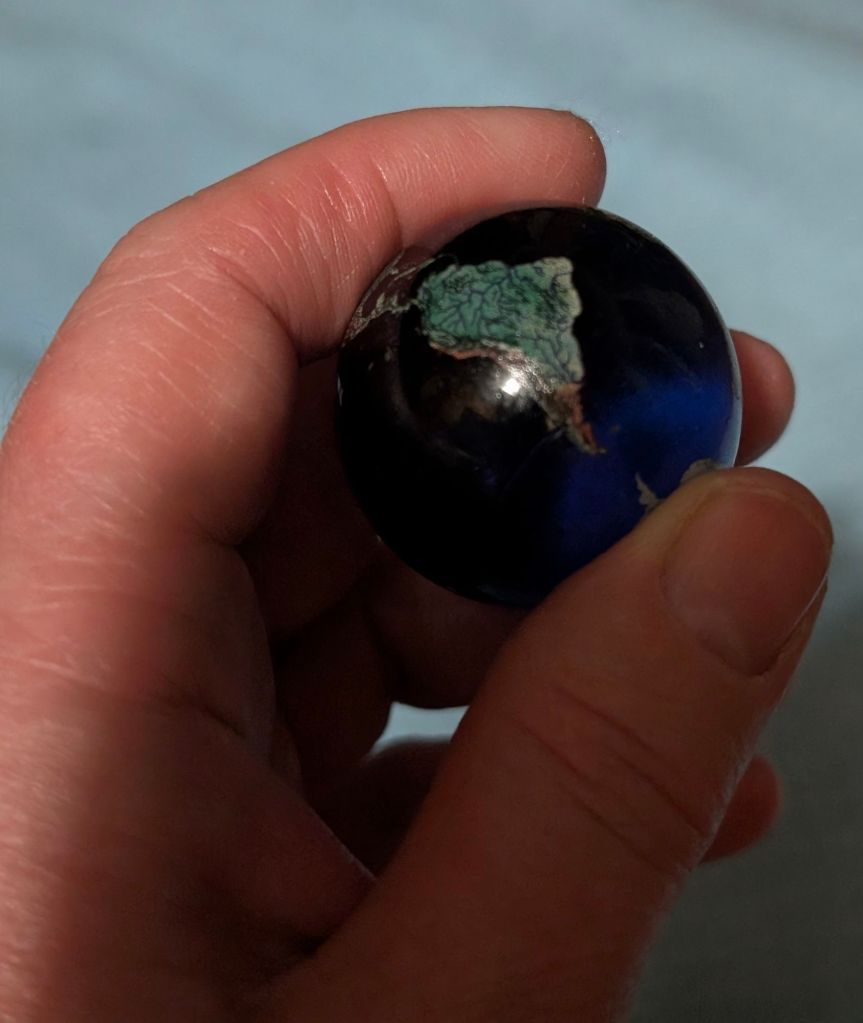
I carry a marble in my pocket.
It is not a toy, exactly. It is a lesson. When I take it out and hold it in my palm, a child will almost always reach for it, and when I let them hold it, something changes. The child slows down. They turn it over. They roll it between their palms and feel that it has no flat sides, no corners, no place where it stops. It just keeps rolling.
That marble is a sphere. Once a child has held one and really felt it, I can ask one question: “What do you see that is a sphere?” And off they go—an orange, a ball, the round knob on the door. They are looking at the whole world differently because of one small thing they held in their hand.
I work part of my week at a preschool that is not a Montessori school. There are no pink towers there, no golden beads, but Montessori is not the materials and the philosophy can happen anywhere!
So I have started keeping lessons in my pockets. A die for a cube. A button. A smooth stone. A small bell. A piece of string. Each one is a whole lesson, because a real lesson for a young child was never about having a shelf full of things. It is about one thing, offered at the right moment, with enough time and quiet for the child to concentrate on it.
Here is what I have learned from carrying lessons in my pocket.
One object holds attention better than twenty. A young child surrounded by choices often chooses nothing for long. But one object, placed in the hand, becomes the whole world for a few minutes. Those few minutes of real concentration are worth more than an hour of drifting from toy to toy.
Concentration is not something we can demand. We can only set up the conditions for it—and one interesting thing, held in the hand, is the simplest condition I know.
The hands learn first. A child who has felt the difference between rough and smooth with their own fingertips knows it in a way no picture can teach. A child who has held something heavy in one hand and something light in the other understands weight. The pocket lessons all start the same way: here, hold this. Examine it. Take your time. The examination is the lesson. My talking is mostly decoration.
Waiting is the hardest work of a child’s day. Children wait in lines, in waiting rooms, in cars, at restaurant tables, while adults finish conversations. We hand them a screen because we do not know what else to do with the waiting. A pocket lesson is something else to do with it. A small container with beans inside, shaken and guessed at. A knot in a cord to work loose with patient fingers. A bell rung once, listened to in silence until the sound is completely gone. The waiting becomes the work, and the work is the child’s own.
Interest cannot be scheduled, but it can be carried. I cannot know which moment of the day a child will be ready to concentrate. I can only be ready when the moment comes. A marble in the pocket is readiness. It costs almost nothing, weighs almost nothing, and asks for nothing but a minute of my attention and a question worth answering.
The marble is back in my pocket now. Tomorrow it might be a key, or a shell, or a stone from the river. The lesson is whatever the child is ready to hold.
© 2026 Nissa Newton · cosmicnissa
The booklet and the printable packet are free: Download the booklet (PDF) and Download the printable packet (PDF).
Further reading: The Tao of Teaching by Greta Nagel





Leave a Reply