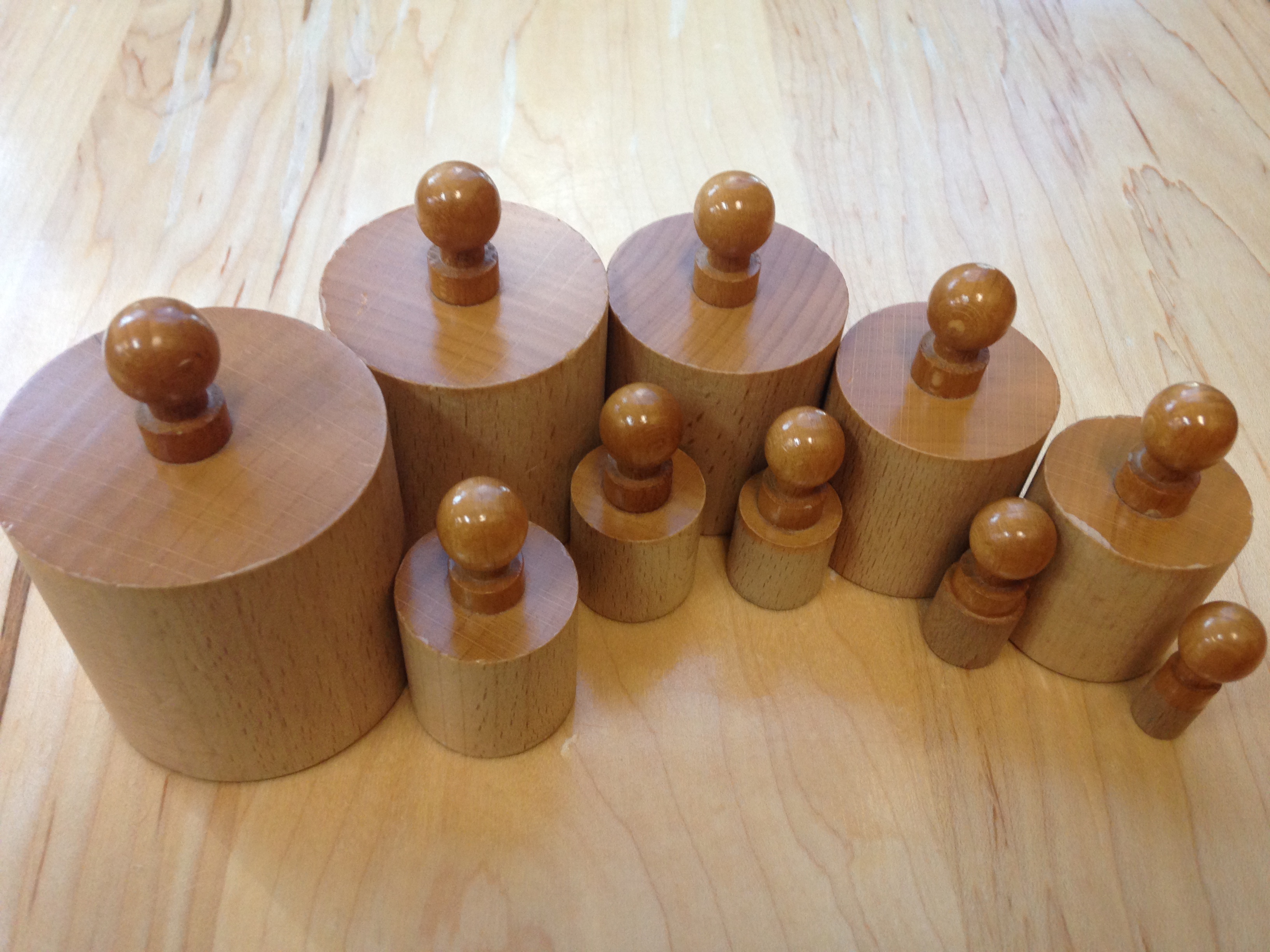
Cylinder Block Exercises

2014-10-03 08.27.19

“There naturally follows as the result of the repetition of this exercise a sharpening of the eye in making distinctions, a greater keenness in observation, and a greater attentiveness in carrying out a systematic operation; and this in turn stimulates the reasoning power, which notices and corrects its errors.” (p. 125, para. 2)

For those that have not had formal Montessori Training, the purposes behind the Montessori materials may not be realized.  One mysterious work is the solid insets, more commonly called cylinder blocks.  These blocks contain groups of ten cylinders.   Maria discusses the composition of the insets in great detail down to the size in decreasing diameters, heights or both.   An additional benefit of the exercise is that when the child removes and replaces the cylinder using the small knobs on top, they are using their pincer grip muscle, preparing the child for holding a pen or pencil.

The spaces inside the block act as a control of error for the student.  In the cylinder set that differentiates itself in height alone, the child will notice when the wrong cylinder into the wrong space. It will be evident as the cylinder will either stick out too far or be swallowed up by the hole.  In another set, where all the cylinders are the same height and differentiate by width alone, the correction may occur at the end when one cylinder is left that does not fit into the remaining hole.  At this point, the child will need to look to see where the error was made.  When the cylinder block contains cylinders of different widths and heights, the control of error still exists and the child continues to learn to distinguish different dimensions at a more complex level.


Montessori, M. (1972). The Exercises. In The discovery of the child (pp. 123-125) New York: Ballantine.

Simple facts and truths

photo“This is our mission: to cast a ray of light and pass on.” (p. 111, para. 2)

Thoughts after read 7. The Exercises “How a Teacher Should Give a Lesson: Comparison with Older Systems”

The Montessori teacher provides simple lessons for the child. Every word in the lesson is thought out to provide factual information to the child with a limited amount of words. Too much information can be distracting and can take the focus off the purpose of the lesson. The teacher’s desire should be to spark interest and wonder in a child. If the lesson excites the child they will get the material out and work with it without being asked.

Maria describes situations in which a teacher will go on and on about their lesson to the child reaching beyond what they need to know. The child may become confused or get stuck in the story, never understanding the true meaning of the lesson. Maria gives the example of a traditional teacher teaching a child about the shape of the square. This teacher goes on about how many sides it has and the number of corners, making the square much more complicated than it has to be. In the Montessori Classroom this would be as simple as pointing at the square inset and tracing it with your fingers stating, “This is a square.” Maria points out that in this simple lesson the child is not even required to count to four. In this simple and precise manner, the child is not confused and understands the purpose of the lesson.

The teacher should be a rainbow to a child, gently casting light on lessons for the child to learn, opening them up to desire to reach their own understanding. Then the teacher fades back into the background while the child explores on their own. It is a beautiful dance in the classroom to watch, the teacher floating around the room casting light about her students encouraging them to sparkle from inside.

Montessori, M. (1972). The Exercises. In The discovery of the child (pp. 106-112) New York: Ballantine

Allowing Inner Discipline and Independence to Develop

IMG_8362[1]

“It is our object to train the child for activity, for work, for doing good, and not for immobility or passivity. It would seem to me that children are very well disciplined indeed when they can all move around in a room in a useful, intelligent, and free fashion without doing anything rude or unmannerly.” (p. 54 para. 3)

Thoughts after reading: 3. Teaching Methods Employed in the Children’s Houses

Many wonder how discipline works in a Montessori Classroom. It is hard for many to imagine an environment in which allows the child so much freedom which also maintains a sense of order.  The environment  and the philosophy used in a Montessori classroom helps the child develop inner discipline.  They learn to find joy in their own accomplishment instead of seeking attention and rewards from the adult.

When the Montessori teacher intervenes, she does so without judging the child, but teaches the child through modeling, asking the child questions, or by redirecting the activity. Today when I was observing a classroom, a teacher reminded a child the proper use of an art material by asking him questions. In a Socratic way, the other students within hearing range were also remembering how they are to all to use the art materials. After the student answered the questions, the other children went quietly back to their own activities. The child who had either forgotten or decided to take a short cut, happily went to get the proper equipment and did not feel shamed or embarrassed.

The freedom allowed in the Montessori classroom, gives the child the opportunity to develop independence.  Montessori classrooms are designed for the child to do for themselves.  If they need something, they can go get it.  If something spills, they can clean it up.  When adults do things for children that they can do for themselves they are doing the child a disservice.

“We wait upon our children; and to serve them in this way is not less fatal than to do something that would tend to suffocate their own useful, spontaneous actions.” (p. 57, para. 4)

Montessori, M. (1972). Teaching methods employed in the children’s houses. In The discovery of the child (pp. 64-75) New York: Ballantine

In the beginning, there were fifty children

rose bud (1 of 1)

“I had nothing more than fifty extremely poor, ragged, obviously timid children,  many of whom where weeping….  A room had been set aside in the apartment house which these children lived, and I was invited to take care of this place of refuge, so the children would not be left abandoned on the stairs, where they would dirty up the walls and be a source of annoyance.” (p.113, para.4-5)

Thoughts after reading The Secret of Childhood, Part II: 18. The Education of the Child

The beginning of Montessori’s work began really like a science experiment. She had very little to offer the 50 children.  Since she had done work with mentally disabled youth, Maria had some tools available to her to try with her disadvantaged 3-6 year olds. Her students surprised her with their use of materials and their ability to concentrate. The children seemed rested and content when given the opportunity to engage in such concentration and focused activity.

In today’s world many children are over stimulated. Too much stimulation can be exhausting for a child. Maria’s classroom was not immersed with toys to tire a child, but meaningful and purposeful activities that helped the child feel good about themselves. Maria was amazed at the child’s mental state upon completing activities. She said the children’s minds were healthier and stronger after engagement.

What stands in the way of a child’s learning? Sometimes it is an adult that does for a child what they can do for themselves. Sometimes it is an environmental factor that stresses a child. Or it could be a nutritional or health issue holding the child back. removing distractions opens up the child’s minds for learning and  to listen to their inner yearning to develop physically and emotionally. As parents and educators we should be observant enough to recognize these obstacles and help break down the barriers in order to free the child’s spirit.

Montessori, M., & Costelloe, M. J. (1972). Introduction, Childhood: A Social -Problem. The secret of childhood (pp. 109-118). New York: Ballantine Books. (Original work published 1966)

The importance of developing senses


SAMSUNG

Montessori, M., & Costelloe, M. J. (1972). Introduction, Childhood: A Social -Problem. The secret of childhood (pp. 100-102). New York: Ballantine Books. (Original work published 1966)

Thoughts after reading PART 1: 16. Lack of Comprehension

“The soul is constantly being nourished with the sight of natural beauties like the rising of the sun, or the delightful vision of a work of art, or with the sound of melodious voices or instruments….  If there were no ego to take delight in these various sights and sounds, what good would there be in these elaborate organs of sense?” (p.102, para. 1-2)

Part of the Early Childhood curriculum in a Montessori Classroom includes sensorial exercises.  Building sensorial skills brings concrete meaning to ideas that without experience are abstract. Sensorial activities help the child differentiate, categorize and grade smells, sounds, flavors, colors, sizes and textures.  Through his senses, the child learns to understanding the world around them and developing meaningful vocabulary, helping him to express himself and connect to his environment.  When a child feels a rough material, he connects the feeling with the meaning of the word, gaining understanding beyond basic comprehension.

Mastery of movement

IMG_7356[1]

Montessori, M., & Costelloe, M. J. (1972). Introduction, Childhood: A Social -Problem. The secret of childhood (pp. 96-99). New York: Ballantine Books. (Original work published 1966)

Thoughts after reading PART 1: 15. Movement

“A child has a natural desire to master the voluntary use of his organs of movement. If he fails to do so, he cannot externalize the fruit of his intelligence.” (p. 99, para. 1)

Every purposeful movement we make is connected to our mind. Our thoughts align with our movements. A child is working to master this connection between their mind and body. Maria emphasizes the importance of movement in the development of intelligence and reasoning abilities.

It is one thing to know how to do something, but quite another to have mastered the physical ability to perform the task. Some activities require a great deal of practice or even special muscle development. One may understand the mechanics behind performing a front flip; however, it is quite a different skill to perform the gymnastic feat.

In a Montessori classroom, children learn through movement. Many children have learn to care for their environment. Various lessons include the gathering of materials from the shelf to a work area. Many classrooms have a line for children to practice balancing on. In addition to gross motor movement, many of the classroom’s practical life exercises involve very precise movements developing fine motor skills, including the pincer grip in preparation for writing. When learning the sounds of the letters, children touch and trace each sound practicing the muscle movement associated with writing the letter.

The will of a child

IMG_7353[1]

Montessori, M., & Costelloe, M. J. (1972). Introduction, Childhood: A Social -Problem. The secret of childhood (pp. 91-95). New York: Ballantine Books. (Original work published 1966)

Thoughts after reading PART 1: 14. The Substitution of the Personality

“The ability to move about under the guidance of reason and not simply in response to the sensible stimuli leads to concentration, and this fixation of the mind and activity upon a single object is a phenomenon of inner origin.” (p. 95, para. 2)

Children want to do what the adult is doing. They copy and imitate, even if they do not understand what they are imitating. Maria suggests that adults can impose their will on the child, acting through the child to accomplish tasks in the way the adult would want them accomplished. The better approach is to allow the child to develop their own will through inspiring them, instead of directing them.

If you have ever witnessed a Montessori teacher give a lesson, you will notice that she is very calm in her presentation and performs each motion in a purposeful manner at a pace that a child can easily begin practicing. Every little detail is shown to the child, from the grasp of a spoon to transferring the very last piece of grain. The goal of the teacher is to inspire the child to seek his own mastery of the skill, concentration, and self-discipline.

Many would expect that children are normally rambunctious and energetic; Montessori philosophy offers a different perspective. In Montessori classrooms, normalization of children comes about as a response to the classroom environment. Observers are often surprised at how quiet and serious the children seem when they are concentrating in the classroom. The normalized child is acting with their own will and self-driven inner discipline.


Purposeful hands

 IMG_7355[1]

Montessori, M., & Costelloe, M. J. (1972). Introduction, Childhood: A Social-Problem. The secret of childhood (pp. 80-87). New York: Ballantine Books. (Original work published 1966)

Thoughts after reading PART 1: 12. The Hand

“Sometimes very small children in a proper environment develop a skill and exactness in their work that can only surprise us.” (p. 87, para 2)

Children want to touch things. Use of their hands is an important development, essential for human life. Maria reminds us how we use hands to express ourselves, ceremoniously, and for essential human activity. In spite of their importance, many children are told repetitively not to touch certain items and to keep their hands to themselves.

Children are interested in doing what they see the adults doing. They want to be part of their family and participate as others do. Work that may seem mundane to an adult, can be very meaningful to child. Sometimes as parents it is so easy to jump in and do a task quickly, even though the child wants to help. Allowing them the opportunity to carry, to pour, to fold, to wash, or to sweep gives them purpose.

A Montessori classroom provides an environment for which controlled movements can be perfected. You will find that many Montessori students love to help in the kitchen, as they have practiced pouring and cutting exercises at school. A parent may look at a Montessori classroom and ask where the toys are; however, one may not understand that the child finds joy in an environment that they can take care of and which allows them to practice activities they want to do.