How does mindfulness and Montessori Philosophy compliment each other?

Mindfulness is a practice of being present in the moment. Some accomplish this through meditation. Others focus on their breathing. One could also observe every sensation their body experiences or the natural environment around them. When I think of mindfulness and Montessori, I reflect on how one does “a work”. There is such intentionality in every movement and focused concentration of the exercise at hand.

During my own Montessori training, I discovered a new way of being. Instead of moving through the world in a daze, I learned to slow down and to pay attention. During my training, I was a single parent with two young children. I was recovering from trauma, so a lot was plowing through my cluttered brain. Because the lessons I was learning to teach required focus and concentration, the activities cleared my mind. All there is is the work. Children see the teacher’s deliberate, careful movements, and when it is their turn, they can also become mindful and focused. This is an important part of the Montessori normalization process of the child.

“The child who has become normalized is truly a worker-a child who, with deep joy, is absorbed in his work, and whose personality is calm, attentive, and respectful” – Maria Montessori

I think back to Karate Kid, when Mr. Miyagi teaches Daniel to focus on activities like “wax on, wax off” or catching a fly with chopsticks. All of these exercises taught movement, focus, and concentration. Like Montessori lessons, martial arts benefits from mindfulness.

“Your mind is like water. When it’s turbulent, it’s difficult to see. But if you become calm, you can see your reflection.” – Mr. Miyagi

Mindfulness and Montessori Philosophy goes beyond the classroom lessons. It spills out into a way of life. In this new way of being, one is self-aware and can regulate emotions. Other benefits can include enhanced relationships where empathy and understanding abound and a sense of peace. When you are present there is more purpose because you are living a life of intention.


Montessori Approach to Parenting Adult Children

I have reached a stage in my life where my children are grown. Although they faced hardships as young people, they have become independent. They are freethinking individuals who want to make a positive change in the world. I couldn’t ask for more!

“Peace is what every human being is craving for, and it can be brought about by the humanity through the child.” – Maria Montessori

If we raise children to be lifelong learners, they could truly impact the future of our planet. Allow them to develop and nurture their compassion for others. One thing I have to remember is to listen. I should not try to solve any problems that arise unless they ask for help. They need to have the opportunity to experience success and failure. So, keeping in line with Montessori principles, they experience the outcomes of their choices. No one tries to fix their mistakes for them. Often, just like me, they just want someone to listen while they work out their solutions.

I am not a fan of the approach of ‘now that you are 18, you need to move out and support yourself.’ I suppose this is like teaching your child to swim by throwing them into the water. We live in a world where this could lead to desperation. Choices are more limited while they are trying to figure out how to “adult”. I prefer going into the water with them. I show them and help them learn. At the same time, I gently encourage them to start swimming on their own.

So for a child entering adulthood it is important to watch and see what they are confident in and see what they ask for help with in order to develop their own independence separate from you. Be available to help, but try not to do what they can do for themselves.

For a young adult learning to take care of their bodies it could be helping them learn about health insurance, selecting a doctor, making appointments, and picking up prescriptions. They may need guidance regarding money management and learning how to use money to take care of their environment. They may request assistance in budgeting, opening bank accounts, how to make deposits, transfer money, paying bills, and taxes. These tasks when accomplished or mastered builds confidence and independence.

Parenting an adult should be a balance between showing, assisting, and acknowledgment of their ability with the goal of building their own intrinsic value and confidence that will allow them the freedom and independence to swim on their own.

Journey Back to the Classroom

IMG_5918

I spent the last ten years without the title: Montessori Teacher. Those that know me, know that it is rare to have an in depth conversation with me without the subject turning to Montessori Philosophy and the value it has had for me, not only when I was a teacher but in the way I desire to treat others.

My most recent job adventure was a sales position. I went to call on a couple of my friends who had started their own Montessori school. During the visit, I was perplexed by the comment regarding their disbelief that I was no longer teaching.

Then I asked myself, If it wasn’t about how much money you make, then what would I be doing?

Teaching.

Why?

Because I believe what Maria said,”Within the child lies the fate of future.”

About 12 years ago, a young first-grade student was writing in her daily journal and was obviously distressed and upset. She told me that she hated cancer. Cancer killed her dog and hurt other people in her family. I responded what do you want to do about it? This young person organized a school walk around the playground raising money fight cancer. Another student, in the same class, was upset that people didn’t have enough to eat and she organized a food drive for a local homeless shelter. I want to emphasize that they did it, these young people with their passion decided how to make difference. They were not shut down or even coddled, but guided at a young age to create change instead of standing idly by. With this beautiful philosophy, possibility stays open for these young people and they do not have to fall into status-quo because they experience ultimate freedom to choose and act.

I am now starting to see students I had over a decade ago evolve into young adults. Nothing gives me as much joy as watching as they blaze new paths, having had the background of Montessori education. They learn that they can try anything and that they can independently choose to make a difference in the world.

Cylinder Block Exercises

2014-10-03 08.27.19

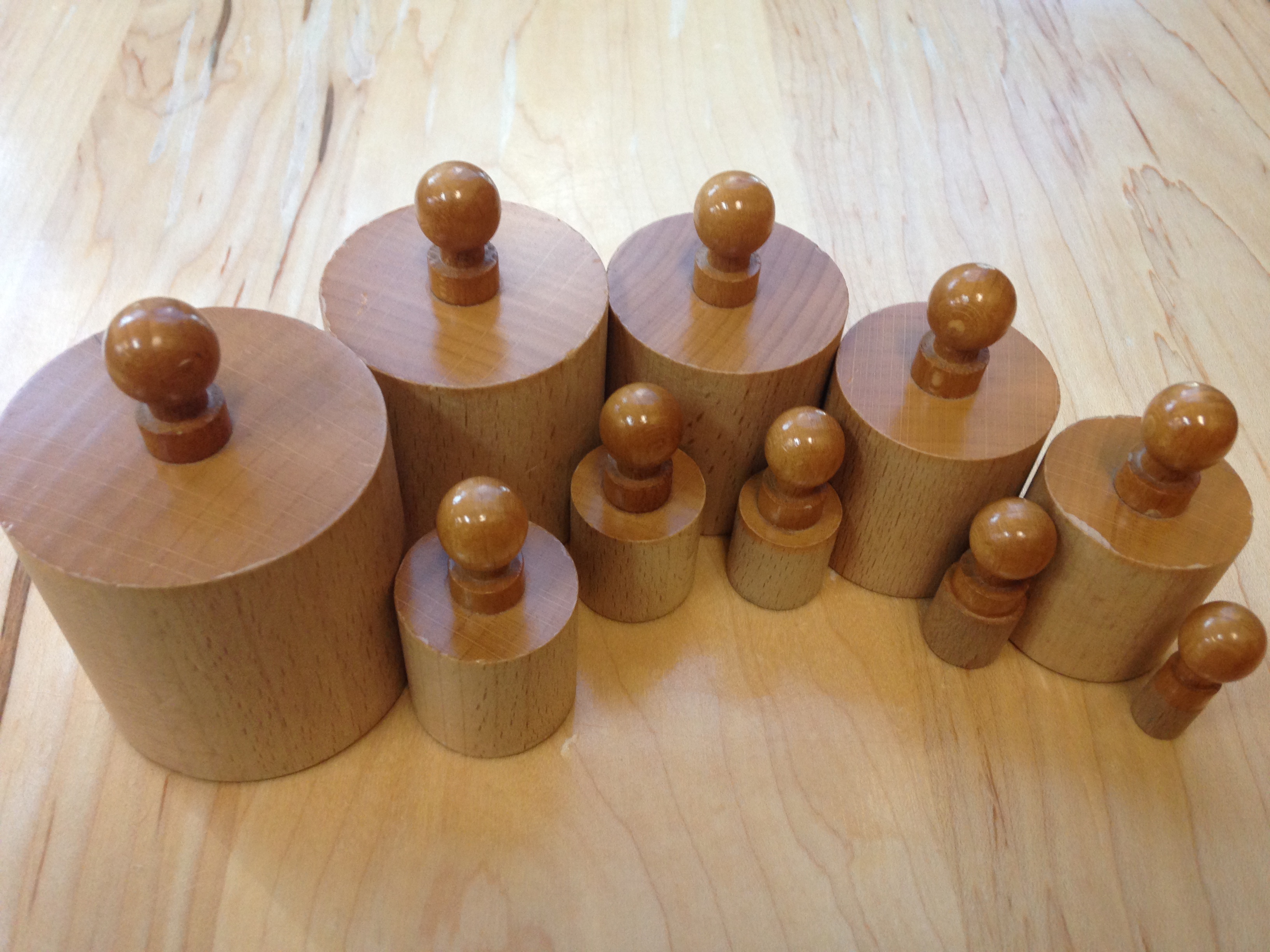
“There naturally follows as the result of the repetition of this exercise a sharpening of the eye in making distinctions, a greater keenness in observation, and a greater attentiveness in carrying out a systematic operation; and this in turn stimulates the reasoning power, which notices and corrects its errors.” (p. 125, para. 2)

For those that have not had formal Montessori Training, the purposes behind the Montessori materials may not be realized.  One mysterious work is the solid insets, more commonly called cylinder blocks.  These blocks contain groups of ten cylinders.   Maria discusses the composition of the insets in great detail down to the size in decreasing diameters, heights or both.   An additional benefit of the exercise is that when the child removes and replaces the cylinder using the small knobs on top, they are using their pincer grip muscle, preparing the child for holding a pen or pencil.

The spaces inside the block act as a control of error for the student.  In the cylinder set that differentiates itself in height alone, the child will notice when the wrong cylinder into the wrong space. It will be evident as the cylinder will either stick out too far or be swallowed up by the hole.  In another set, where all the cylinders are the same height and differentiate by width alone, the correction may occur at the end when one cylinder is left that does not fit into the remaining hole.  At this point, the child will need to look to see where the error was made.  When the cylinder block contains cylinders of different widths and heights, the control of error still exists and the child continues to learn to distinguish different dimensions at a more complex level.


Montessori, M. (1972). The Exercises. In The discovery of the child (pp. 123-125) New York: Ballantine.

Touch and Movement

IMG_8775[1]

“Little children, in fact, touch everything they see, thus obtaining a double image (visual and muscular) of the countless different objects they encounter in their environment.” (p.116, para 2)

When a teacher presents the sounds of the alphabet to the child, she does so by saying the sound and tracing the shape of the sound with her finger.  She then invites the child to do the same.  The presentation of the lesson incorporates auditory, visual, and touch.  The movement of the tracing develops muscle memory and connects their movement to the image they see.  When children begin writing their muscles will remember the movements they traced when introduced to the letter.

Students grade, sort and match sensorial objects isolating the skills associated with differentiating objects using the senses.  They work towards mastery and in some cases enjoy doing the matching using a blindfold.  They enjoy developing the ability to see with their hands!

Montessori, M. (1972). The Exercises. In The discovery of the child (pp. 116-120) New York: Ballantine.

Focused Movement in Practical Life Exercises

2014-09-09 18.19.25 HDR

“One single idea runs through every complex activity, and this single idea must be sought as the key to any general problem. There is also a secret key to the perfecting of the most varied types of movements. And the key is balance.”

Thoughts after reading: 5. Education in Movement (Part 2)

For the young child perfecting movement is important in developing control and mastery over their bodies. The implementation of practical life into the classroom allows the child to practice repetitive movements that help them conquer daily challenges in life and develop habits which can last them a lifetime. During my Early Childhood teacher training, I was amazed at my unrefined movements. I have always rushed through life, diving into the next thing, often bumping into coffee tables, spilling drinks, and walking heavy footed. Learning to slow down and pay attention to small movements to show the child was great practice for me. One of my favorite lessons is how to shut the door. I had never thought about this simple task beyond opening and shutting. The lessons shows the child how the doorknob works and how to turn the knob so the bolting mechanism go inside as the door is shutting and gently releases when the door is in place. The task is successful when the door closes without a sound.

Other activities practiced in practical life could be buttoning, zipping, latching, pouring, using locks and keys, opening containers, walking around obstacles, carrying objects, shoe tying, blowing noses, washing hands, washing a desk, polishing shoes, and much, much more. If I had been a Montessori child and practiced perfecting practical life skills, my adult life would be much easier. My clothes would last longer, I would experience less injuries, I would move about quieter and I would not have to redo tasks. Taking the Montessori training did help me slow down and appreciate each movement that is related to a task and appreciate the child’s efforts to perfect their own movements.

Montessori, M. (1972). Education in Movement. In The discovery of the child (pp. 88-90) New York: Ballantine

Allowing children to help is essential

IMG_8633[1]
“Even the littlest children are anxious to do something and are more anxious to exert themselves than those who are older. A good teacher will therefore look for some way in which even the tiniest child can be of help.” (p. 84, para. 2)

Thoughts after reading: 5. Education in Movement

Every child seeks to be useful and part of the community. The youngest ones are the most eager to help. We should not discourage their interest in helping us. Their desire can prove more useful than we can imagine and the benefit to their soul is tremendous. Given tasks of importance makes them work very hard to perform to perfection. The trick is to not guide them so directly that their independence is replaced with puppet strings. The other thing to remember is that a little task can mean a lot to a child. Tasks in which they can gain that internal reward of accomplishment are very important.

“Of itself movement is something unrefined, but its value increases when one attempts to perfect it…. When children experience pleasure not only from an activity leading towards a special goal but also in carrying it out exactly in all its details, they open up a whole new area of education for themselves.” (p. 85, para. 3)

I am in awe of my own children’s organization skills. Perhaps their own time spent amongst Montessori materials organizing and sorting succeeded in perfecting their own sense of order.

My youngest daughter put together packets of information for me at work. She organized each part of the packet, counted their parts to insure the right amount, and created a process of assembling. Even at the age of 10, she was excited and enthusiastic about helping. I allowed her to create her own process and allowed her to accomplish it on her own. I believe this contributed to her own feeling of success.

After the first day of school, my eight grade daughter came home and made a plan regarding what she we would need for each class and how many trips she would need to go to her locker. She plans ahead for assignment and sets goals for herself beyond what the assignment calls for. I never have to worry about her not finishing her work. Although I watch her progress, I can see that she does not need me to assist with her planning and her results of success are indeed her own and not mine.

Montessori, M. (1972). Education in Movement. In The discovery of the child (pp. 76-88) New York: Ballantine

Priority #1 is the Child

untitled (1 of 1)-3

“The greatest crime that society commits is that of wasting the money which it should use for children on things that will destroy them and society itself….” (p.214, para.1)

Thoughts after reading Part III. 30. The Rights of the Child

Maria demands that society set its priorities straight.  The child is the most important investment in the future of our world, yet often budgetary and funding choices within the home or government do not show this.  So many lives could be changed if more effort was placed on creating the proper environment for children to prosper in the home and at school.  Parents should be prepared for the great responsibility of child rearing, understanding their responsibility goes beyond just the physical health of their child.  The greatest thing a parent can do is love their child beyond their own self, placing their needs beyond their own.  This does not mean catering and being a slave to your child’s whim.  It means thinking about was is best for your child.  Do your research, seek to understand the child, become an observer and respond to their natural development that is unfolding before you.

I have now completed Maria Montessori’s Secret of Childhood.  I hope you have enjoyed this journey with me. I look forward to my next read:  The Discovery of the Child.

Montessori, M., & Costelloe, M. J. (1972). Introduction, Childhood: A Social -Problem. The secret of childhood (pp. 209-216). New York: Ballantine Books. (Original work published 1966)


Embrace your maternal instincts!

2014-03-09 09.51.26

“Maternal instinct” is thus a generic definition given to the guiding instinct that is concerned with the preservation of the species. It has certain characteristics that are common to all living creatures. For one thing, it demands a sacrifice of all other adult instincts.” (p.201, para.5)

Thoughts after reading Part III: 28. Guiding Instincts

Montessori describes the deep sacrifice made by other creatures on behalf of their offspring; the bird build a nest, bees build a beehive, and spiders become intimately attached to their egg sack. Their instincts guide them to give their offspring what they need at the perfect time for their development. Yet as adults, we try to mold the children to fit into our adult world, instead of creating the nurturing environment they need in order to grow, “He acts as a butterfly would act that would break the cocoon of its larva to encourage it to fly. Or he acts like a frog that would draw its tadpole out of the water so that it might breathe on land….” (p.205, para. 2)

We may not be able to perfectly sacrifice ourselves as other animal species do for their children; however, being aware of our selfish tendencies can allow us to open our eyes to the child’s perspective and make changes that could benefit our children . A child needs an emotional and physical environment that is suitable for their development. As they grow and change their environment also needs to shift to support those needs.

Montessori, M., & Costelloe, M. J. (1972). Introduction, Childhood: A Social -Problem. The secret of childhood (pp. 199-206). New York: Ballantine Books. (Original work published 1966)

Letting the child do for himself

IMG_1651

“Our concept of the education of children thus differs not only from those who do everything for a child themselves but also from those who think they can leave the child in a purely passive environment. It is therefore not enough to prepare objects for children adapted in size shape to their needs: adults must also be trained to help them.” (p. 198, para. 3-4)

Thoughts after reading Part III: 26. The Instinct to Work

The Montessori teacher helps the child perform tasks alone and they are trained to observe the and guide the child based on their individual needs. It is a disservice to prevent a child’s natural growth and development. Children need to act for themselves in order become independent adults who can learn, think and act for themselves.  When the action is accomplished the child is elated and their confidence blossoms. When they are interrupted they may feel discouraged to try again or they may become too dependent on the adult to do for them.

Before jumping into assist the child, take a few minutes to watch. If the child is having difficulty and asks for help, try to model the action for them in distinct and easy to follow motions that they can copy on their own. Try to be patient and do not rush the child as they try to perform the task. If the child seems intent on their task, let them continue to work on it on their own. If they accomplish the task entirely on their own, they will experience intrinsic reward of accomplishment.

Montessori, M., & Costelloe, M. J. (1972). Introduction, Childhood: A Social -Problem. The secret of childhood (pp. 185-198). New York: Ballantine Books. (Original work published 1966)