
Training the Senses

2014-04-12 16.43.09

“The development of the senses actually precedes that of higher intellectual faculties, and in a child between ages three and six it constitutes his formative period.” (p.143 para. 4)

Montessori education focuses on helping the child develop naturally and during his Early Childhood years a child is growing and adapting to his environment around them.  They are attracted primarily to discover things they can discover through their senses.  What a key time to hone in on observation skills as well as discerning slight differences between stimuli!  Often children in this age group truly enjoy the sensorial exercises where that practice sorting, organization, and grading exercises picking up on the smallest differences and elements that can attribute to their success in their future careers.

One example is the chef who may need to determine how much more seasoning to add to a dish using sight, taste or smell.  A doctor may need to be able to pick up on various symptoms through observing with their senses such as listening carefully to heartbeat.

Montessori, M. (1972). Generalizations on the training of the senses. In The discovery of the child (pp. 143-152) New York: Ballantine.
Cylinder Block Exercises

2014-10-03 08.27.19

“There naturally follows as the result of the repetition of this exercise a sharpening of the eye in making distinctions, a greater keenness in observation, and a greater attentiveness in carrying out a systematic operation; and this in turn stimulates the reasoning power, which notices and corrects its errors.” (p. 125, para. 2)

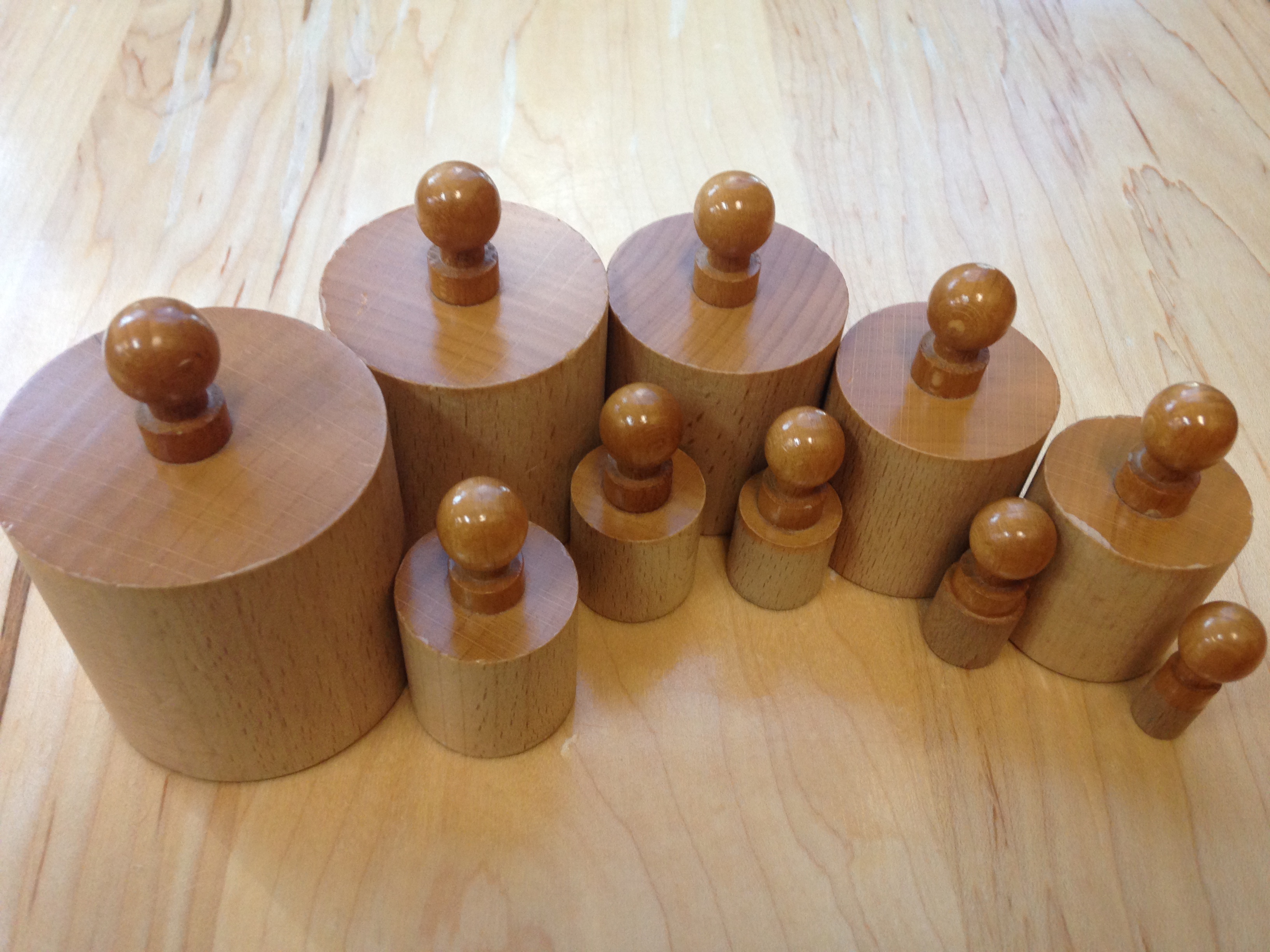
For those that have not had formal Montessori Training, the purposes behind the Montessori materials may not be realized.  One mysterious work is the solid insets, more commonly called cylinder blocks.  These blocks contain groups of ten cylinders.   Maria discusses the composition of the insets in great detail down to the size in decreasing diameters, heights or both.   An additional benefit of the exercise is that when the child removes and replaces the cylinder using the small knobs on top, they are using their pincer grip muscle, preparing the child for holding a pen or pencil.

The spaces inside the block act as a control of error for the student.  In the cylinder set that differentiates itself in height alone, the child will notice when the wrong cylinder into the wrong space. It will be evident as the cylinder will either stick out too far or be swallowed up by the hole.  In another set, where all the cylinders are the same height and differentiate by width alone, the correction may occur at the end when one cylinder is left that does not fit into the remaining hole.  At this point, the child will need to look to see where the error was made.  When the cylinder block contains cylinders of different widths and heights, the control of error still exists and the child continues to learn to distinguish different dimensions at a more complex level.


Montessori, M. (1972). The Exercises. In The discovery of the child (pp. 123-125) New York: Ballantine.

Montessori Fundamentals: aesthetics, activity, control of error and limits

2014-03-05 07.41.54

“The training and sharpening of the senses has the obvious advantage of enlarging the field of perception and of offering an ever more solid foundation for intellectual growth.” (p.99, para. 2)

Thoughts after reading: 6. The Material for Development

The classroom itself is organized and aesthetically pleasing to the child. Having a beautiful environment for the child calls the child to work or activity. It also helps them develop a sense of care and concern for their environment. They water the plants, dust the shelves, sweep the floor, straighten books, and place objects where they belong. They feel that their classroom is their own and they are proud of the care that they give to the classroom. Children want a sense of belonging.

Montessori materials help prepare a young mind for science. The materials teach the child about order and categorization. Each sensorial material isolates a single focus for the child such as weight, size, length or color. If a child is using a material in which color is the focus contained needs to be the same. Everything else about the items in the exercise must be the same. Touch pads look the same, but have different textures. Color spools are all identical, but have different colors. Bells are the same, but have different sounds. After the child does the work, they must be able to self correct, using their own reasoning to identify their own mistakes and make their own corrections.

Limitation is key in the Montessori classroom. Not every student can do the same activity, but choose for themselves work that is available. If another student is using what they want they have the choice to observe, wait or select another activity.

Montessori, M. (1972). The Material for Development. In The discovery of the child (pp. 99-105) New York: Ballantine

Letting go to allow the child to learn

IMG_8708[1]

“Everything must be taught, and everything must be connected with life; but this does not mean the actions which children have learned to perform and to integrate with their practical lives should be suppressed or directed by us in every detail….How he is to use what he has learned is a task for his own conscience, an exercise of his own responsibility. “ (p.93, para. 3)

Thoughts after reading: 5. Education in Movement (Part 3)

The lesson is separate from the implementation of what was learned. Montessori Lessons introduce the child to exercises or materials for them to do for themselves.   They are mostly self-correcting and through practice the child can develop personal satisfaction in their ability. A child does not learn through imitation, but through immersing themselves in their own work. Although it may be difficult to pull back from the child as he becomes involved in his work, it is essential. Montessori warns that the teacher can be the child’s biggest obstacle. The child benefits from choosing work for himself that he is drawn to and from working with the work without disruption.

The child must also be allowed the opportunity to use the skills they learn, in their everyday world without being told exactly how to do it. The child should synthesize their learning in the real world. They should determine for themselves what action they ought to perform in relationship to the circumstance. Adult coaching holds the adult accountable for the child’s action, preventing the child from developing their own sense of responsibility.

Montessori, M. (1972). Education in Movement. In The discovery of the child (pp. 91-98) New York: Ballantine

Focused Movement in Practical Life Exercises

2014-09-09 18.19.25 HDR

“One single idea runs through every complex activity, and this single idea must be sought as the key to any general problem. There is also a secret key to the perfecting of the most varied types of movements. And the key is balance.”

Thoughts after reading: 5. Education in Movement (Part 2)

For the young child perfecting movement is important in developing control and mastery over their bodies. The implementation of practical life into the classroom allows the child to practice repetitive movements that help them conquer daily challenges in life and develop habits which can last them a lifetime. During my Early Childhood teacher training, I was amazed at my unrefined movements. I have always rushed through life, diving into the next thing, often bumping into coffee tables, spilling drinks, and walking heavy footed. Learning to slow down and pay attention to small movements to show the child was great practice for me. One of my favorite lessons is how to shut the door. I had never thought about this simple task beyond opening and shutting. The lessons shows the child how the doorknob works and how to turn the knob so the bolting mechanism go inside as the door is shutting and gently releases when the door is in place. The task is successful when the door closes without a sound.

Other activities practiced in practical life could be buttoning, zipping, latching, pouring, using locks and keys, opening containers, walking around obstacles, carrying objects, shoe tying, blowing noses, washing hands, washing a desk, polishing shoes, and much, much more. If I had been a Montessori child and practiced perfecting practical life skills, my adult life would be much easier. My clothes would last longer, I would experience less injuries, I would move about quieter and I would not have to redo tasks. Taking the Montessori training did help me slow down and appreciate each movement that is related to a task and appreciate the child’s efforts to perfect their own movements.

Montessori, M. (1972). Education in Movement. In The discovery of the child (pp. 88-90) New York: Ballantine

Allowing children to help is essential

IMG_8633[1]
“Even the littlest children are anxious to do something and are more anxious to exert themselves than those who are older. A good teacher will therefore look for some way in which even the tiniest child can be of help.” (p. 84, para. 2)

Thoughts after reading: 5. Education in Movement

Every child seeks to be useful and part of the community. The youngest ones are the most eager to help. We should not discourage their interest in helping us. Their desire can prove more useful than we can imagine and the benefit to their soul is tremendous. Given tasks of importance makes them work very hard to perform to perfection. The trick is to not guide them so directly that their independence is replaced with puppet strings. The other thing to remember is that a little task can mean a lot to a child. Tasks in which they can gain that internal reward of accomplishment are very important.

“Of itself movement is something unrefined, but its value increases when one attempts to perfect it…. When children experience pleasure not only from an activity leading towards a special goal but also in carrying it out exactly in all its details, they open up a whole new area of education for themselves.” (p. 85, para. 3)

I am in awe of my own children’s organization skills. Perhaps their own time spent amongst Montessori materials organizing and sorting succeeded in perfecting their own sense of order.

My youngest daughter put together packets of information for me at work. She organized each part of the packet, counted their parts to insure the right amount, and created a process of assembling. Even at the age of 10, she was excited and enthusiastic about helping. I allowed her to create her own process and allowed her to accomplish it on her own. I believe this contributed to her own feeling of success.

After the first day of school, my eight grade daughter came home and made a plan regarding what she we would need for each class and how many trips she would need to go to her locker. She plans ahead for assignment and sets goals for herself beyond what the assignment calls for. I never have to worry about her not finishing her work. Although I watch her progress, I can see that she does not need me to assist with her planning and her results of success are indeed her own and not mine.

Montessori, M. (1972). Education in Movement. In The discovery of the child (pp. 76-88) New York: Ballantine

Allowing Inner Discipline and Independence to Develop

IMG_8362[1]

“It is our object to train the child for activity, for work, for doing good, and not for immobility or passivity. It would seem to me that children are very well disciplined indeed when they can all move around in a room in a useful, intelligent, and free fashion without doing anything rude or unmannerly.” (p. 54 para. 3)

Thoughts after reading: 3. Teaching Methods Employed in the Children’s Houses

Many wonder how discipline works in a Montessori Classroom. It is hard for many to imagine an environment in which allows the child so much freedom which also maintains a sense of order.  The environment  and the philosophy used in a Montessori classroom helps the child develop inner discipline.  They learn to find joy in their own accomplishment instead of seeking attention and rewards from the adult.

When the Montessori teacher intervenes, she does so without judging the child, but teaches the child through modeling, asking the child questions, or by redirecting the activity. Today when I was observing a classroom, a teacher reminded a child the proper use of an art material by asking him questions. In a Socratic way, the other students within hearing range were also remembering how they are to all to use the art materials. After the student answered the questions, the other children went quietly back to their own activities. The child who had either forgotten or decided to take a short cut, happily went to get the proper equipment and did not feel shamed or embarrassed.

The freedom allowed in the Montessori classroom, gives the child the opportunity to develop independence.  Montessori classrooms are designed for the child to do for themselves.  If they need something, they can go get it.  If something spills, they can clean it up.  When adults do things for children that they can do for themselves they are doing the child a disservice.

“We wait upon our children; and to serve them in this way is not less fatal than to do something that would tend to suffocate their own useful, spontaneous actions.” (p. 57, para. 4)

Montessori, M. (1972). Teaching methods employed in the children’s houses. In The discovery of the child (pp. 64-75) New York: Ballantine

Allowing the child to follow his passion

IMG_1230

“Everyone has a special inclination or special secret, hidden vocation. It may be modest but it is certainly useful. An award can divert such a calling and turn one’s head to the loss of his true vocation.” (p.16, para.1)

Thoughts after reading 1. On the Application of Science to the School

Punishments and Rewards can be abused to make a child conform to rules.   Teachers and parents should not make demands on children as if they have unlimited authority. Instead we should guide the child, helping him find his own way to pursue his own innate talents and gifts. The problem with awards and punishments is they are externally driven. As adults, we may seek endless external rewards making decisions based on the external rewards that may be achieved. We may take a job that is less satisfying yet has a promising future even though our passions lay somewhere else. Wouldn’t we be happier if we were driven by the vocations that we were designed for?

In a Montessori setting, teachers encourage the child to find his passion and support them on their unique educational journey. Although they have to study required subjects there is the opportunity to go deeper into areas they are interested in and really develop their talents. The children learn to appreciate each other’s differences and recognize individual contributions to the community. Every child has something special to offer the world, as long as we do not pull them off their path.

Montessori, M. (1972). On the application of science to the school. In The discovery of the child (pp. 1-18). New York: Ballantine.