Guiding Six Year Olds

Chapter 1: The Six-Year-Old Confronted with the Cosmic Plan

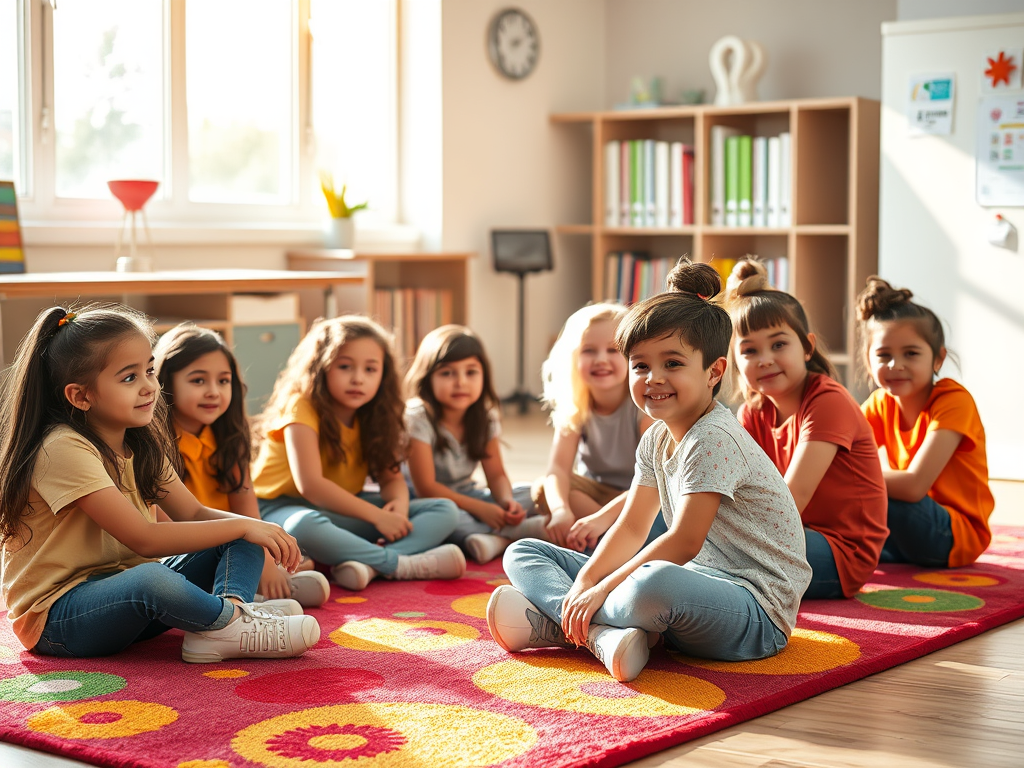
As I jump back into Montessori Philosophy reading blog, I decided to start with To Educate the Human Potential. Six year olds are intrigued by nature and can use their imagination to learn lessons about earth and our existence. One thing that is difficult in this age of media and entertainment is so much exposure to stimulation where imagination is derailed towards other endeavors such as superheroes, villains, fantastical creatures, and fantasy through so much gaming and streaming. For young people it can be confusing to determine what is real. Think about how much more they would gain using their imagination to connect with our science, math, language, and sociology? Without the distraction of media influences they can absorb so much more of the actual world around them.

As a teacher it was much harder to connect with young people that lived in a fantasy world. You would actually have to meet them in their imagined world to connect with them and then try to get them interested in other endeavors beyond fantasy play. The pretend kitchen, with pretend faucets’, plastic food, pretend stoves, and useless fridges. In the outdoors these kitchens produce bark mulch concoctions that are inedible. What would they rather do? Bring them into a real kitchen. Have them help prepare real food and learn how to use a real kitchen safely with the reward of food to eat and share with others.

Chapter one starts by pointing out the difference in personality that occurs around six year olds that make them very receptive to cultural lessons. Montessori recommends sowing as many seeds of interest as possible. This way the seed is there waiting for germination later.
Another important matter for six year olds is the development of moral activity. During this time they are trying out their own judgement and trying to impose their judgements on others. “An inner change has taken place, but nature is quite logical in arousing understanding, but a claim to mental independence, a desire to distinguish good from evil by his own powers, and to resent limitation by arbitrary authority.”

Six year olds also need to participate in organized activity, mixing with others in a group. It is normal for groups to develop leaders that the others obey. It is natural for mankind to organize itself and these young people will be able to use their morality, sense of right and wrong, to be part of organized society later in life.

At this age it is also important to allow the child to learn by their own activity and allow them to follow their choices and has a need for exercising their own mind. In Montessori philosophy teachers are considered guides not dictating what it is they need to learn but giving them what they need to satisfy their curiosity. Montessori says they must have ABSOLUTE freedom of choice. This frees the teacher from syllabuses and time , but the teacher needs to be knowledgeable in every subject so the teacher can help the student in their endeavors. “We shall walk together on this path of life, for all things are part of the universe, and are connected with each other to form a whole unity. This idea helps the minds of the child to become satisfied, having found the universal center of himself with all things.”

In my experience, there are many Montessori schools that are not true to guiding students and instead impose assigned school work, worksheets, and homework. This is not in line with Montessori philosophy. I’ve had my share of sheets tracking which lessons a student has had and where they are at on their not so self led journey. In these environment I even feel a lack of freedom. If I am not free as a teacher, how can expect the students to feel they have real choices and are learning what they are wanting to learn. When I am at my best as a teacher, I am afloat watching and observing the actions of the children, thinking about what work they would want to do and looking to see how I might help draw their interest to new areas. My real work is in preparing the environment. The key to this preparation is observing the classroom.

Training the Senses

2014-04-12 16.43.09

“The development of the senses actually precedes that of higher intellectual faculties, and in a child between ages three and six it constitutes his formative period.” (p.143 para. 4)

Montessori education focuses on helping the child develop naturally and during his Early Childhood years a child is growing and adapting to his environment around them.  They are attracted primarily to discover things they can discover through their senses.  What a key time to hone in on observation skills as well as discerning slight differences between stimuli!  Often children in this age group truly enjoy the sensorial exercises where that practice sorting, organization, and grading exercises picking up on the smallest differences and elements that can attribute to their success in their future careers.

One example is the chef who may need to determine how much more seasoning to add to a dish using sight, taste or smell.  A doctor may need to be able to pick up on various symptoms through observing with their senses such as listening carefully to heartbeat.

Montessori, M. (1972). Generalizations on the training of the senses. In The discovery of the child (pp. 143-152) New York: Ballantine.

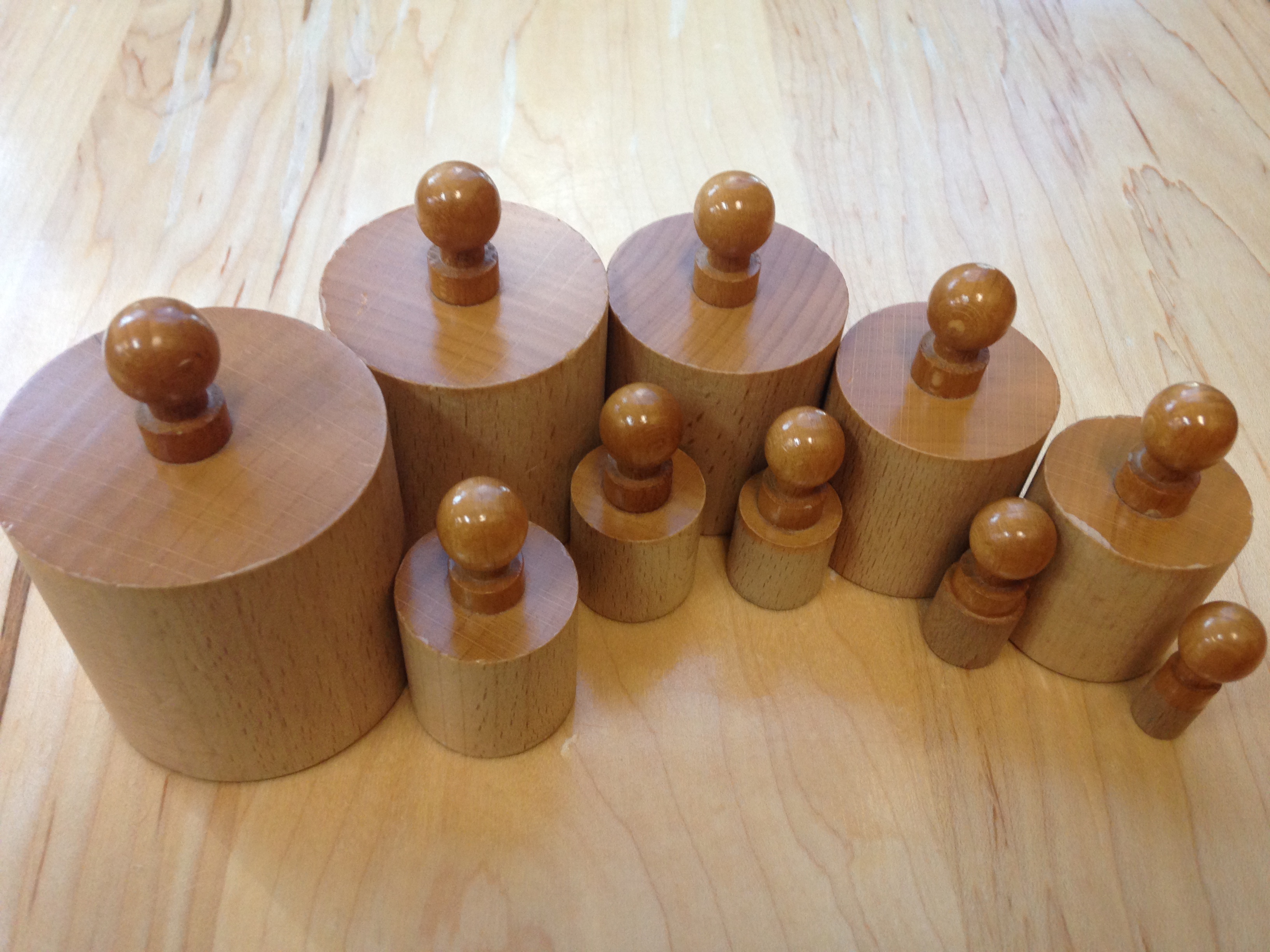
Cylinder Block Exercises

2014-10-03 08.27.19

“There naturally follows as the result of the repetition of this exercise a sharpening of the eye in making distinctions, a greater keenness in observation, and a greater attentiveness in carrying out a systematic operation; and this in turn stimulates the reasoning power, which notices and corrects its errors.” (p. 125, para. 2)

For those that have not had formal Montessori Training, the purposes behind the Montessori materials may not be realized.  One mysterious work is the solid insets, more commonly called cylinder blocks.  These blocks contain groups of ten cylinders.   Maria discusses the composition of the insets in great detail down to the size in decreasing diameters, heights or both.   An additional benefit of the exercise is that when the child removes and replaces the cylinder using the small knobs on top, they are using their pincer grip muscle, preparing the child for holding a pen or pencil.

The spaces inside the block act as a control of error for the student.  In the cylinder set that differentiates itself in height alone, the child will notice when the wrong cylinder into the wrong space. It will be evident as the cylinder will either stick out too far or be swallowed up by the hole.  In another set, where all the cylinders are the same height and differentiate by width alone, the correction may occur at the end when one cylinder is left that does not fit into the remaining hole.  At this point, the child will need to look to see where the error was made.  When the cylinder block contains cylinders of different widths and heights, the control of error still exists and the child continues to learn to distinguish different dimensions at a more complex level.


Montessori, M. (1972). The Exercises. In The discovery of the child (pp. 123-125) New York: Ballantine.

Letting go to allow the child to learn

IMG_8708[1]

“Everything must be taught, and everything must be connected with life; but this does not mean the actions which children have learned to perform and to integrate with their practical lives should be suppressed or directed by us in every detail….How he is to use what he has learned is a task for his own conscience, an exercise of his own responsibility. “ (p.93, para. 3)

Thoughts after reading: 5. Education in Movement (Part 3)

The lesson is separate from the implementation of what was learned. Montessori Lessons introduce the child to exercises or materials for them to do for themselves.   They are mostly self-correcting and through practice the child can develop personal satisfaction in their ability. A child does not learn through imitation, but through immersing themselves in their own work. Although it may be difficult to pull back from the child as he becomes involved in his work, it is essential. Montessori warns that the teacher can be the child’s biggest obstacle. The child benefits from choosing work for himself that he is drawn to and from working with the work without disruption.

The child must also be allowed the opportunity to use the skills they learn, in their everyday world without being told exactly how to do it. The child should synthesize their learning in the real world. They should determine for themselves what action they ought to perform in relationship to the circumstance. Adult coaching holds the adult accountable for the child’s action, preventing the child from developing their own sense of responsibility.

Montessori, M. (1972). Education in Movement. In The discovery of the child (pp. 91-98) New York: Ballantine

Focused Movement in Practical Life Exercises

2014-09-09 18.19.25 HDR

“One single idea runs through every complex activity, and this single idea must be sought as the key to any general problem. There is also a secret key to the perfecting of the most varied types of movements. And the key is balance.”

Thoughts after reading: 5. Education in Movement (Part 2)

For the young child perfecting movement is important in developing control and mastery over their bodies. The implementation of practical life into the classroom allows the child to practice repetitive movements that help them conquer daily challenges in life and develop habits which can last them a lifetime. During my Early Childhood teacher training, I was amazed at my unrefined movements. I have always rushed through life, diving into the next thing, often bumping into coffee tables, spilling drinks, and walking heavy footed. Learning to slow down and pay attention to small movements to show the child was great practice for me. One of my favorite lessons is how to shut the door. I had never thought about this simple task beyond opening and shutting. The lessons shows the child how the doorknob works and how to turn the knob so the bolting mechanism go inside as the door is shutting and gently releases when the door is in place. The task is successful when the door closes without a sound.

Other activities practiced in practical life could be buttoning, zipping, latching, pouring, using locks and keys, opening containers, walking around obstacles, carrying objects, shoe tying, blowing noses, washing hands, washing a desk, polishing shoes, and much, much more. If I had been a Montessori child and practiced perfecting practical life skills, my adult life would be much easier. My clothes would last longer, I would experience less injuries, I would move about quieter and I would not have to redo tasks. Taking the Montessori training did help me slow down and appreciate each movement that is related to a task and appreciate the child’s efforts to perfect their own movements.

Montessori, M. (1972). Education in Movement. In The discovery of the child (pp. 88-90) New York: Ballantine

Freeing the child from external pressure

IMG_7721[1]

“Their parents were illiterate, and their teacher an ordinary working woman, without ambition and without preconceptions. This led to a kind of intellectual calm.” (p.137, para. 2)

Thoughts after reading Part II: 20. The “Method”

Teachers are under pressure to have their students perform well on tests. Placing expectations on what the student’s potential should be may limit or discourage the child. When a child puts their heart and soul into an assignment and gets negative feedback  their confidence can be shattered.

Montessori noticed that one of the key ingredients in the Children’s Home success was that the teacher did not have personal ambition attached to the child’s performance. Regardless of what the children accomplished, the teacher would not feel worried or concerned.  Freedom from expectations, allows one to be free from external pressures. The goal of a Montessori education is to help the child develop his own potential.  Freeing him from the expectations, allows him to set his own goals and aspirations.

Montessorians want students to experience self-accomplishment, developing intrinsic motivation which refines self-discipline. Every year in our Lower Elementary Program for 1st -3rd grade, our students create a Passion Project.  This is a report about a topic the student is passionate about.   I observed the students sharing information from their projects with each other and I saw each child gaining credibility with their peers and self-confidence. Free from external expectations, the child experiences their own success and sense of accomplishment.


Montessori, M., & Costelloe, M. J. (1972). Introduction, Childhood: A Social -Problem. The secret of childhood (p. 136-142). New York: Ballantine Books. (Original work published 1966)