“There naturally follows as the result of the repetition of this exercise a sharpening of the eye in making distinctions, a greater keenness in observation, and a greater attentiveness in carrying out a systematic operation; and this in turn stimulates the reasoning power, which notices and corrects its errors.” (p. 125, para. 2)
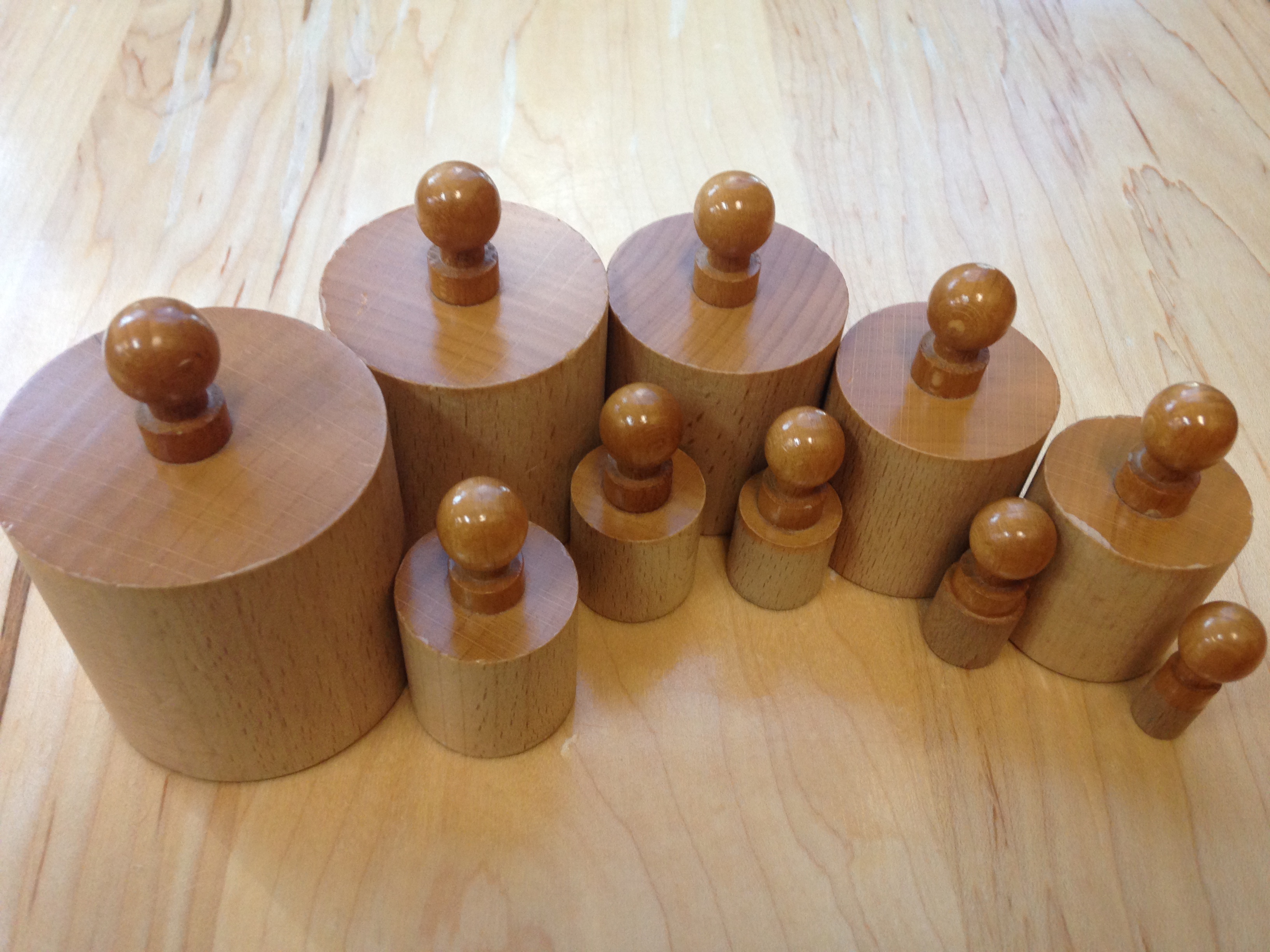
For those that have not had formal Montessori Training, the purposes behind the Montessori materials may not be realized. One mysterious work is the solid insets, more commonly called cylinder blocks. These blocks contain groups of ten cylinders. Maria discusses the composition of the insets in great detail down to the size in decreasing diameters, heights or both. An additional benefit of the exercise is that when the child removes and replaces the cylinder using the small knobs on top, they are using their pincer grip muscle, preparing the child for holding a pen or pencil.
The spaces inside the block act as a control of error for the student. In the cylinder set that differentiates itself in height alone, the child will notice when the wrong cylinder into the wrong space. It will be evident as the cylinder will either stick out too far or be swallowed up by the hole. In another set, where all the cylinders are the same height and differentiate by width alone, the correction may occur at the end when one cylinder is left that does not fit into the remaining hole. At this point, the child will need to look to see where the error was made. When the cylinder block contains cylinders of different widths and heights, the control of error still exists and the child continues to learn to distinguish different dimensions at a more complex level.
Montessori, M. (1972). The Exercises. In The discovery of the child (pp. 123-125) New York: Ballantine.
 Montessori Philosophy